Closing the Gap:
Infrastructure Financing in CEMAC
How Central Africa Can Look to Its Own Markets to Fund Infrastructure
and Reduce Reliance on Foreign Capital
Date: June 2026 .
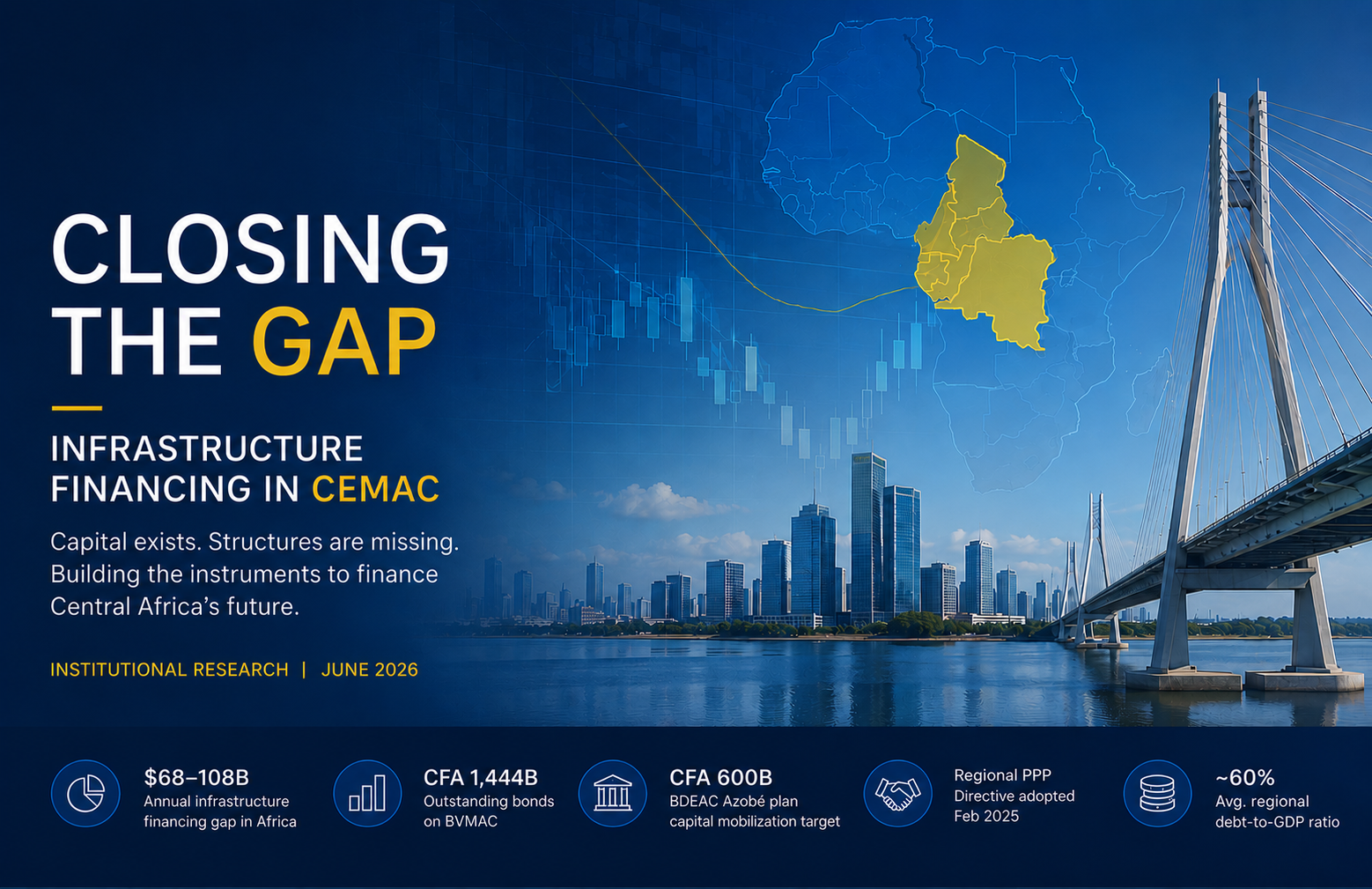
INVESTMENT THESIS SUMMARY The CEMAC region faces an infrastructure deficit that is structural, measurable, and directly constraining economic growth. Africa requires between $130–$170 billion annually in infrastructure investment, with an unmet gap of $68–$108 billion per year. Within CEMAC, six countries accounting for over 65 million people and roughly $150 billion in combined GDP, the problem is particularly acute. This is no longer primarily a capital availability problem. It is a financial intermediation and structuring problem. The capital exists in regional banking systems, institutional investor pools, BEAC reserves, and international DFI pipelines but the mechanisms to channel it productively into bankable, long-duration infrastructure projects remain underdeveloped. Key Findings: • The BVMAC bond market holds CFA 1,444 billion in outstanding debt, dominated by sovereign issuers (between 80-90% historically), underlining the near-total absence of project finance bonds. • CEMAC’s new regional PPP directive (February 2025) is a significant regulatory moment, but national transposition within 12-18 months is required for it to be operative. • BDEAC’s Azobé 2023–2027 strategic plan targets CFA 1,895 billion in project financing, with CFA 600 billion earmarked for regional capital market mobilization. It is the first systematic attempt to use BVMAC as an infrastructure funding vehicle. In March 2024, a multi-tranche bond issue was launched as the first phase of financing. • Blended finance, partial credit guarantees, and project bonds represent viable near-term structures for mobilizing private capital at scale • Beko Capital Advisory is committed to structuring DFI co-financing facilities, arranging infrastructure project bonds on BVMAC, and advising governments on PPP transaction structuring. 1. The Infrastructure Deficit: Scale and Context1.1 The Continental PictureAfrica’s infrastructure gap is one of the most consequential constraints on the continent’s economic potential. The African Development Bank estimates that the continent requires between $130 billion and $170 billion annually in infrastructure investment across roads, energy, water, ports, and telecommunications. Current expenditure falls far short: Africa invests only 4% of its GDP in infrastructure, compared with 14% in China. The resulting annual deficit of $68–$108 billion represents not just a development shortfall but a direct drag on economic growth, with the AfDB estimating that closing the gap could boost GDP growth by up to 2 percentage points per year. The macro environment is compounded by unit costs. Energy costs for manufacturing enterprises in Africa are up to four times higher than peer markets; road freight tariffs are roughly twice those of the United States; and mobile and internet services cost approximately four times as much as in South Asia. These premium costs are, in significant part, a function of infrastructure inadequacy. They act as a structural tax on private investment, productivity, and regional integration. 1.2 CEMAC DimensionsWithin this continental picture, the CEMAC region (comprising Cameroon, Gabon, Congo, Chad, Equatorial Guinea, and the Central African Republic) faces a particularly severe structural deficit, compounded by a high reliance on commodity revenues that have historically substituted for diversified, long-duration public investment. Regional infrastructure investment is essential to unlocking stronger CEMAC growth. The data is stark:
CEMAC’s fiscal position further constrains the public investment capacity that historically financed infrastructure. The region’s average fiscal balance swung from a surplus of 0.6% of GDP in 2023 to a deficit of 1.5% in 2024, driven by lower oil revenues and increased spending pressures. 2. CEMAC’s Financial Market Architecture: Where Things Stand2.1 The BVMAC: An Underutilized PlatformThe Bourse des Valeurs Mobilières de l’Afrique Centrale (BVMAC), headquartered in Douala and serving all six CEMAC member states, is the institutional backbone of the region’s capital markets. As of June 1st, 2026, BVMAC’s total market capitalization reached CFA 1,710 billion. The equity market remains thin, with only seven listed companies (BGFI Holding Corporation, Socapalm, Safacam, SEMC, La Régionale, Bange, and SCG-Ré). The bond market is more active and represents a realistic near-term vehicle for infrastructure financing. Outstanding bond debt exceeded CFA 1,444 billion as of June 1st, 2026, driven primarily by BDEAC issuances and sovereign paper from Gabon and Cameroon. 2.2 BDEAC: The Anchor InstitutionThe Development Bank of Central African States (BDEAC) has emerged as the most consequential domestic institution in the CEMAC infrastructure financing ecosystem. BDEAC has become a primary source of investor returns, with six listed bond lines and interest rates ranging from 4.7% to 6.2%. In 2023 alone, BDEAC paid out CFA 57 billion of the CFA 76.5 billion in total interest distributed across the market, representing 74.5% of all investor returns on the exchange. BDEAC’s Azobé 2023–2027 Strategic Plan is the most ambitious financing program in the region’s recent history. The plan targets total resource mobilization of CFA 1,895 billion, with CFA 600 billion earmarked specifically for the regional financial and monetary markets. In a landmark 2024 issuance, BDEAC introduced the first multi-tranche bond structure in the region’s history, offering maturities of 3, 5, and 7 years at rates of 4.70%, 5.95%, and 6.20% respectively, and exceeded its CFA 50 billion target, closing at CFA 54.7 billion following oversubscription. A follow-on CFA 65 billion credit line was secured from Afreximbank in June 2025 to further expand the bank’s deployment capacity. BDEAC’s mandate under Azobé explicitly encompasses regional infrastructure projects involving multiple member states, along with private sector structuring support, positioning it as the natural co-arranger and credit enhancer for any serious infrastructure bond program. 2.3 BEAC and the Monetary BackdropThe Banque des États de l’Afrique Centrale (BEAC) plays a dual role in the infrastructure financing equation. As the issuer of the CFA franc, pegged to the euro at a fixed rate of CFAF 655.957 per euro, BEAC provides a measure of monetary stability that, in principle, should reduce currency risk for long-duration infrastructure investment. BEAC’s treasury securities market has become an increasingly important financing mechanism for sovereign borrowers. This market serves shorter maturities (13 weeks–7 years), while BVMAC is better suited to the longer-duration paper (7–15 years) that infrastructure projects require. 2.4 Regulatory Developments: COSUMAF and the Regional PPP DirectiveCOSUMAF (Commission de Surveillance du Marché Financier de l’Afrique Centrale) has taken concrete steps to expand the range of instruments available on the BVMAC. Its regulatory reforms broadened the market’s product set, and its published guide for green, sustainable, and social (GSS) bonds (covering renewable energy, pollution prevention, biodiversity, and green transport) establishes the framework for sustainability-linked infrastructure bonds. BVMAC’s February 2026 launch of the ESPro incubator program, targeting the preparation of private sector companies for IPO and bond issuance with support from AfDB, IFC, and AFD, signals an institutional commitment to deepening the issuer base. Another consequential regulatory development is the adoption of CEMAC’s regional PPP directive in February 2025. For the first time, a harmonized legal framework exists for private sector participation in large-scale regional infrastructure projects, standardizing PPP contracts, clarifying risk allocation, and establishing the methodology for project prioritization and feasibility assessment. Its effective operationalization depends on national transposition by all six member states within 12-18 months. 3. The Limits of Foreign Capital Dependency3.1 The Structural ArgumentCEMAC infrastructure has historically been financed through three external channels: bilateral lending (predominantly from China and France), multilateral DFI disbursements (World Bank, IFC, AfDB, EIB, AFD etc.), and sovereign Eurobonds. Each channel has played a meaningful role, but each also carries dependencies, conditions, and structural risks that make over-reliance a strategic vulnerability. Chinese bilateral financing, which drove a significant share of CEMAC infrastructure investment through the 2010s, has decelerated materially. DFI capital is not a substitute for domestic market development. It is typically catalytic, deployed to derisk transactions and attract in private capital. The strategic objective should be to use DFI participation as a credit enhancement mechanism that enables domestic institutional investors and capital market structures to scale, rather than as a permanent solution to the financing gap. The argument for domestic capital mobilization is financial and macroeconomic. Foreign-currency-denominated debt, the dominant form of bilateral and DFI lending, introduces exchange-rate risk. Infrastructure projects typically generate revenues in local currency (utility tariffs, port fees, toll revenues). A structural mismatch between local-currency revenue streams and hard-currency debt service creates fiscal pressure. CEMAC’s financial system holds a substantial but largely un-mobilized stock of domestic capital. Regional commercial banks are well capitalized relative to their loan books, with excess liquidity deposited at BEAC. Regional savings are substantial but largely outside the formal financial system. Insurance companies and pension funds hold long-duration liabilities that, in principle, match the asset duration of infrastructure investment. 4. Financing Structures: A Toolkit for CEMAC InfrastructureThe transition to a domestically anchored financing model requires the deployment of specific financial structures. These structures are not mutually exclusive; the most successful transactions in comparable emerging markets blend multiple instruments. Below we analyze six relevant structures for the CEMAC context. 4.1 Infrastructure Project BondsProject bonds are debt securities issued to finance a specific infrastructure project, with debt service funded from the project’s revenue stream rather than the issuer’s balance sheet. They are a direct mechanism for channeling long-duration capital market savings into infrastructure assets. Project bonds face four structural preconditions: (i) a bankable, revenue-generating project with contractually defined cash flows; (ii) a credible legal and regulatory framework governing the concession or offtake; (iii) an investor base willing to accept project credit risk; and (iv) a sufficient market depth to absorb the issuance. A viable near-term model involves BDEAC as co-issuer or guarantor, with the project bond structured as a BDEAC-backed instrument listed on BVMAC. This reduces investor credit exposure from project-specific risk to BDEAC’s institutional credit risk. 4.2 Blended Finance FacilitiesBlended finance, the strategic use of concessional capital from DFIs and development donors to crowd in private investment on commercial terms, is well-established globally and has growing institutional support. In a typical blended finance structure, a DFI provides first-loss equity or a subordinated tranche, absorbing early-stage risk and reducing the effective cost of capital for senior commercial debt providers. Regional commercial banks which have excess liquidity but limited appetite for long-duration infrastructure risk can participate in senior tranches with improved risk-adjusted returns. BDEAC could occupy the mezzanine position while the financial advisor or investment bank’s role is to structure and arrange the transaction, price the tranches, and assemble the lender syndicate. 4.3 Public-Private Partnerships (PPPs)Some of the PPP structures relevant for CEMAC infrastructure are:
4.4 Partial Credit Guarantees (PCGs) and Risk Mitigation InstrumentsA PCG covers a defined portion of debt service in the event of default, effectively tranching the risk profile of a debt instrument and enabling investors to participate in transactions they would otherwise decline on credit grounds. An infrastructure project bond that carries a partial guarantee from a DFI such as AfDB or IFC, can achieve an investment-grade-equivalent credit profile on the guaranteed portion, making it accessible to insurance companies and pension funds that have minimum credit quality requirements. As the market develops, the guarantee percentage can be reduced over successive transactions. 4.5 Sovereign Wealth Funds and Pension CapitalGabon, Equatorial Guinea, and to a lesser extent Congo, operate or are developing sovereign wealth mechanisms supported by commodity revenues. These vehicles represent potential long-duration, risk-tolerant sources of domestic capital that are philosophically aligned with regional infrastructure investment. Formal pension fund assets remain modest relative to the financing need, and the regulatory frameworks governing pension investment in infrastructure are nascent. The priority is regulatory development: creating the asset class definitions, risk categorizations, and eligible investment frameworks that allow pension funds and insurance companies to allocate to infrastructure project bonds and PPP equity without violating prudential requirements 4.6 Green, Socials, and Sustainability Bonds (GSS Bonds)COSUMAF’s publication of the GSS bond framework positions BVMAC to capture part of the global surge in sustainability-linked capital flows. Green bonds, priced at a premium to conventional equivalents, offer CEMAC infrastructure borrowers the opportunity to access international ESG-mandated investor pools that would otherwise not consider sub-investment-grade, frontier-market paper. The most natural application in CEMAC is renewable energy infrastructure ( hydropower, solar, and sustainable forestry green economy projects). 5. Structural Challenges and Risk FactorsA balanced assessment requires engaging with the structural challenges that constrain the development trajectory outlined in this paper. 5.1 Project Preparation GapThe most persistent constraint in CEMAC infrastructure financing is not the availability of capital but the availability of bankable projects. A “bankable” project — one that has completed technical feasibility studies, environmental and social impact assessments, demand analysis, and financial modeling to the standard required by institutional lenders — takes 2–5 years and significant upfront cost to develop. Many CEMAC projects have not reached this stage. The solution is an adequately funded project preparation facility. The CEMAC Commission’s PPP directive includes a feasibility fund concept; BDEAC, AfDB, AFD and most other DFIs operate project preparation instruments. Connecting these and ensuring they are adequately capitalized is a prerequisite for generating the deal flow that the new financing structures require. 5.2 Market Depth and Investor Base ConcentrationBVMAC’s bond market, while growing, remains shallow and heavily concentrated. Secondary market turnover is insufficient to provide the liquidity that institutional investors require as a precondition for large-scale primary market participation. The ESPro incubator program is a long-run solution; near-term market depth requires more immediate catalysts: state-owned enterprise listings, secondary trading initiatives by BVMAC, and the development of market-making obligations for registered dealers. Without secondary market liquidity, infrastructure bonds will price at significant premiums over their fundamental risk, increasing the cost of capital and reducing project viability. 5.3 Debt Sustainability and Sovereign RiskThe region’s average debt-to-GDP ratio of 62% leaves limited fiscal headroom. Government guarantees for infrastructure projects, where required to make transactions viable, consume fiscal space. Revenue guarantees (minimum traffic payments on toll roads, minimum offtake under energy PPAs) create contingent liabilities that need to be carefully managed. The implication for transaction structuring is that CEMAC infrastructure financing should, where possible, be structured to minimize sovereign balance sheet utilization: project-specific revenue streams, ring-fenced project vehicles, and DFI partial risk guarantees that substitute for sovereign guarantees are the structural tools that achieve this. Transactions designed to reduce fiscal contingent liability while maintaining viability will receive more favorable DFI support and will be more durable across political cycles. 6. ConclusionThe case for a fundamental shift in CEMAC infrastructure financing, from foreign capital dependence to domestically anchored, market-mediated, and regionally integrated, is both urgent and achievable. The scale of the infrastructure deficit is large; the fiscal space to address it through conventional government spending is shrinking; and the international capital flows that historically compensated are retreating or being deployed on tighter terms. The answer must involve domestic capital markets. The enabling conditions for this shift are present. A regional PPP framework exists. COSUMAF has created the regulatory infrastructure for project bonds and GSS instruments. BDEAC has demonstrated that BVMAC can absorb complex, multi-tranche bond structures. The CEMAC Commission has a prioritized project pipeline. International DFIs are actively seeking co-investment partners in Central Africa. The missing elements are solvable over a 5–7 year horizon with the right institutional coordination. IMPORTANT DISCLOSURES This research paper has been prepared by the Beko Capital Advisory Investment Banking Division for informational purposes only and does not constitute investment advice, a solicitation, or an offer to buy or sell any security or financial instrument. The views expressed are based on publicly available information as of the date of publication (June 2026) and are subject to change without notice. Past performance is not indicative of future results. Recipients should conduct their own independent analysis and consult qualified advisers before making any investment or financial decision. This document is intended solely for the use of its authorized recipients. To the fullest extent permitted by applicable law, Beko Capital Advisory disclaims any and all liability for any direct, indirect, incidental, or consequential loss or damage arising from any use of, or reliance on, this document or its contents. No warranty is given, and no responsibility is accepted, regarding the standing of any individual, firm, company, or other organization mentioned herein. Key sources referenced in this paper include: World Bank CEMAC Economic Barometer, IMF Country Reports, African Development Bank publications, Business in Cameroon, and OECD Africa Capital Markets Report 2025. Statistical data referenced is current as of the dates stated. Beko Capital Advisory S.A. is a Public Limited Company with a Board of Directors and capital of CFA 300,000,000 francs, COSUMAF-SDB-03/2021 accreditation Taxpayer number: M031812693640D Head Office: Grassfields Building, 1077 Christian Tobie KUOH street, Bonanjo, PoBox: 2684 Douala/Cameroon Tel: 237 233 43 58 30/ 698 77 48 24 |
Beko Capital has actively taken part in pan-African trades and investments over the years.

Vice President, Head of Investment Banking

