
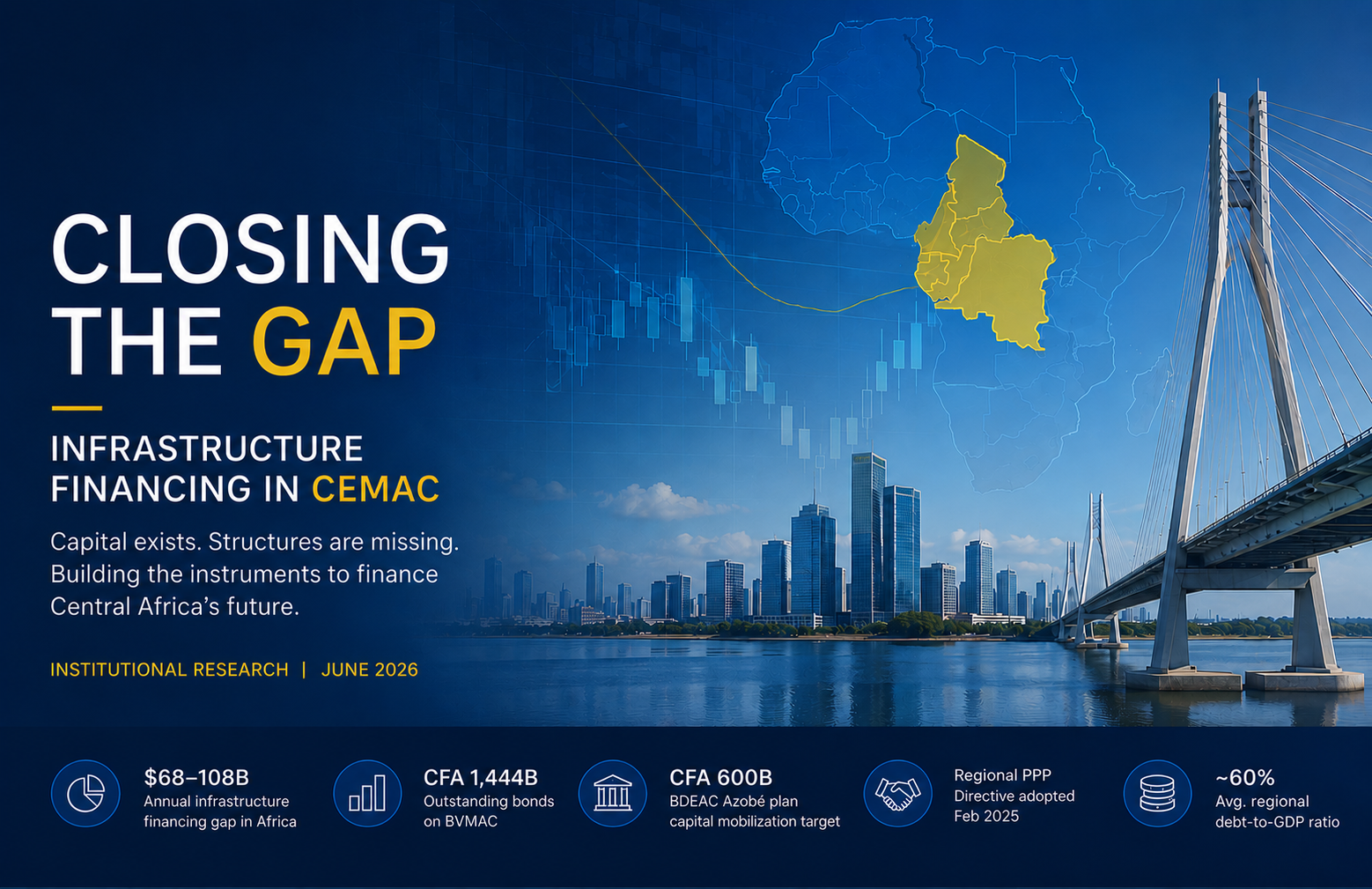
Closing the Gap: Infrastructure Financing in CEMAC Closing the Gap: Infrastructure Financing in CEMAC How Central Africa Can Look to Its Own Markets to Fund Infrastructure and Reduce Reliance on Foreign Capital Date: June 2026 . Executive Summary INVESTMENT THESIS SUMMARY The CEMAC region faces an infrastructure deficit that is structural, measurable, and directly constraining economic growth. Africa requires between $130–$170 billion annually in infrastructure investment, with an unmet gap of $68–$108 billion per year. Within CEMAC, six countries accounting for over 65 million people and roughly $150 billion in combined GDP, the problem is particularly acute. This is no longer primarily a capital availability problem. It is a financial intermediation and structuring problem. The capital exists in regional banking systems, institutional investor pools, BEAC reserves, and international DFI pipelines but the mechanisms to channel it productively into bankable, long-duration infrastructure projects remain underdeveloped. Key Findings: • The BVMAC bond market holds CFA 1,444 billion in outstanding debt, dominated by sovereign issuers (between 80-90% historically), underlining the near-total absence of project finance bonds. • CEMAC’s new regional PPP directive (February 2025) is a significant regulatory moment, but national transposition within 12-18 months is required for it to be operative. • BDEAC’s Azobé 2023–2027 strategic plan targets CFA 1,895 billion in project financing, with CFA 600 billion earmarked for regional capital market mobilization. It is the first systematic attempt to use BVMAC as an infrastructure funding vehicle. In March 2024, a multi-tranche bond issue was launched as the first phase of financing. • Blended finance, partial credit guarantees, and project bonds represent viable near-term structures for mobilizing private capital at scale • Beko Capital Advisory is committed to structuring DFI co-financing facilities, arranging infrastructure project bonds on BVMAC, and advising governments on PPP transaction structuring. 1. The Infrastructure Deficit: Scale and Context 1.1 The Continental Picture Africa’s infrastructure gap is one of the most consequential constraints on the continent’s economic potential. The African Development Bank estimates that the continent requires between $130 billion and $170 billion annually in infrastructure investment across roads, energy, water, ports, and telecommunications. Current expenditure falls far short: Africa invests only 4% of its GDP in infrastructure, compared with 14% in China. The resulting annual deficit of $68–$108 billion represents not just a development shortfall but a direct drag on economic growth, with the AfDB estimating that closing the gap could boost GDP growth by up to 2 percentage points per year. The macro environment is compounded by unit costs. Energy costs for manufacturing enterprises in Africa are up to four times higher than peer markets; road freight tariffs are roughly twice those of the United States; and mobile and internet services cost approximately four times as much as in South Asia. These premium costs are, in significant part, a function of infrastructure inadequacy. They act as a structural tax on private investment, productivity, and regional integration. 1.2 CEMAC Dimensions Within this continental picture, the CEMAC region (comprising Cameroon, Gabon, Congo, Chad, Equatorial Guinea, and the Central African Republic) faces a particularly severe structural deficit, compounded by a high reliance on commodity revenues that have historically substituted for diversified, long-duration public investment. Regional infrastructure investment is essential to unlocking stronger CEMAC growth. The data is stark: In Chad and the Central African Republic, approximately 9 in 10 people lacked reliable electricity access as recently as 2021–2022 according to World Bank Estimates. In the Republic of Congo, half the population lacked electricity access in the same period. Road density across CEMAC is below the African median of 12 km per 100 km², compared to 136 km in high-income countries according to AfDB. Cameroon’s road maintenance budget covers only 4.5% of the national road network (which spans 121,873 km as of end-2024), requiring CFA 1.1 trillion annually for proper maintenance. CEMAC’s fiscal position further constrains the public investment capacity that historically financed infrastructure. The region’s average fiscal balance swung from a surplus of 0.6% of GDP in 2023 to a deficit of 1.5% in 2024, driven by lower oil revenues and increased spending pressures. 2. CEMAC’s Financial Market Architecture: Where Things Stand 2.1 The BVMAC: An Underutilized Platform The Bourse des Valeurs Mobilières de l’Afrique Centrale (BVMAC), headquartered in Douala and serving all six CEMAC member states, is the institutional backbone of the region’s capital markets. As of June 1st, 2026, BVMAC’s total market capitalization reached CFA 1,710 billion. The equity market remains thin, with only seven listed companies (BGFI Holding Corporation, Socapalm, Safacam, SEMC, La Régionale, Bange, and SCG-Ré). The bond market is more active and represents a realistic near-term vehicle for infrastructure financing. Outstanding bond debt exceeded CFA 1,444 billion as of June 1st, 2026, driven primarily by BDEAC issuances and sovereign paper from Gabon and Cameroon. 2.2 BDEAC: The Anchor Institution The Development Bank of Central African States (BDEAC) has emerged as the most consequential domestic institution in the CEMAC infrastructure financing ecosystem. BDEAC has become a primary source of investor returns, with six listed bond lines and interest rates ranging from 4.7% to 6.2%. In 2023 alone, BDEAC paid out CFA 57 billion of the CFA 76.5 billion in total interest distributed across the market, representing 74.5% of all investor returns on the exchange. BDEAC’s Azobé 2023–2027 Strategic Plan is the most ambitious financing program in the region’s recent history. The plan targets total resource mobilization of CFA 1,895 billion, with CFA 600 billion earmarked specifically for the regional financial and monetary markets. In a landmark 2024 issuance, BDEAC introduced the first multi-tranche bond structure in the region’s history, offering maturities of 3, 5, and 7 years at rates of 4.70%, 5.95%, and 6.20% respectively, and exceeded its CFA 50 billion target, closing at CFA 54.7 billion following oversubscription. A follow-on CFA 65 billion credit line was secured from Afreximbank in June 2025 to further expand the bank’s deployment capacity. BDEAC’s mandate under Azobé explicitly encompasses regional infrastructure projects involving multiple member states, along with private sector structuring support, positioning it as the natural

Unlocking Investment Opportunities in Cameroon: A Strategic Investment Destination for UK Capital
The 2026 Iran Conflict: Oil Price Shock and the Implications for African Economies
The 2026 Iran Conflict: Oil Price Shock and the Implications for African Economies The 2026 Iran Conflict: Oil Price Shock and the Implications for African Economies Executive Summary On February 28, 2026, a joint U.S.-Israeli military operation targeting Iran’s nuclear and military infrastructure triggered the most severe global energy supply disruption since the 1970s oil crisis. Iran responded by effectively closing the Strait of Hormuz, the world’s most critical oil chokepoint, through which approximately one-fifth of global crude oil and liquefied natural gas (LNG) supply normally flows. The International Energy Agency (IEA) has characterized the resulting disruption as the greatest global energy and food security challenge in recorded history. As of March 25th, Brent crude was trading at $102 per barrel, representing a more than 42% increase from pre-conflict levels of approximately $72/bbl. The conflict has also driven LNG prices up by nearly 60% and pushed global freight costs sharply higher amid mass suspension of Gulf transit routes by major shipping operators. For Africa, the implications are asymmetric, structural, and potentially destabilizing. The continent’s 54 economies span a wide spectrum from crude oil exporters (Nigeria, Angola, Congo, Gabon) to heavily import-dependent net fuel consumers (Kenya, Ethiopia, Senegal, Tanzania, Rwanda, and most Sahelian nations). This paper examines the macro-level supply shock, its transmission mechanisms into African economies, the differentiated impact across key country groupings, and the strategic outlook for the continent’s policymakers, investors, and sovereign issuers. 1. The Anatomy of the Strait of Hormuz Closure 1.1 Scale and Precedent The closure of the Strait of Hormuz following the onset of conflict on February 28, 2026, constitutes the largest oil supply disruption in the history of global energy markets. The Strait, only 21 nautical miles wide at its narrowest point, serves as the transit corridor for more than 20 million barrels of crude oil per day, roughly one-quarter of all oil traded by sea globally. Unlike the sanctions-driven disruptions of 2022 (Russia-Ukraine), the current crisis involves a physical chokepoint: tanker traffic has nearly halted due to Iranian drone and missile attacks on vessels, making diversification and rerouting inadequate substitutes for lost supply. Iran has launched retaliatory strikes on energy infrastructure across the Gulf, including Saudi Aramco’s Ras Tanura refinery and export terminal, as well as Qatari LNG facilities. Qatar supplies approximately 20% of global LNG. Iraq and Kuwait have curtailed production as onshore storage fills with oil that cannot be exported; the UAE is expected to follow. By mid-March, collective Gulf oil production had fallen by an estimated 10 million barrels per day. Goldman Sachs Research estimates that traders have demanded approximately $14/bbl of geopolitical risk premium above pre-conflict fair-value levels. 1.2 Oil Price Trajectory Brent crude traded at approximately $72 per barrel on February 27, 2026, the day before U.S.-Israeli strikes commenced. The price progression since then has been dramatic: Date Brent Crude Closing Price ($/bbl) Event Feb 27, 2026 $72 Pre-conflict baseline Mar 6, 2026 $93 Largest weekly WTI gain on record Mar 9, 2026 $99 First $100+/bbl since Russia-Ukraine (2022) on Sunday Mar 8 Mar 20, 2026 $112 Iraq declares force majeure, Qatar & Kuwait refineries attacked Mar 23, 2026 $100 Trump gives ultimatum to reopen Strait; Iran threatens to retaliate Mar 25, 2026 $102 War in its 4th week; no resolution 2. Transmission Mechanisms into African Economies The oil price shock reaches African economies through four primary channels: 2.1 Direct Fuel Price Pass-Through Africa imports the overwhelming majority of the refined petroleum products it consumes. Unlike the production disruption of 2022 where diversification and rerouting buffered some economies, the current crisis involves both higher crude input costs and severe shipping disruptions. War-risk insurance premia reportedly jumped tenfold in some maritime lanes shortly after the conflict began. Major global shipping operators have suspended or rerouted Gulf services, adding 10-15 days to Asia-Europe rotations and significantly raising freight rates. Fuel is the single most critical direct input into African consumer price indices. In several African economies, energy and transport account for approximately 15-25% of CPI baskets. The 2022 Russia-Ukraine comparison is instructive: rising crude prices and a weakening rand pushed transport fuel prices in South Africa up by more than 25% within six months. The current shock is of greater magnitude and broader geographic reach. 2.2 Currency Depreciation When global oil prices spike, investors typically move funds into safe-haven assets, primarily the U.S. dollar, at the expense of emerging market currencies. The double effect of higher import costs denominated in USD and a weaker local currency amplifies inflationary pressure for net-importing African economies. This dynamic is already visible in Southern and East Africa, where the rand and the Kenyan shilling have come under pressure. The effect is most severe in economies with already thin FX reserves and high external debt burdens. 2.3 Fertilizer and Food Price Inflation Oil and gas are not just fuels, they are the feedstocks for nitrogen-based fertilizers (urea, ammonia), which are largely produced in the Gulf and exported globally. The Gulf accounts for approximately 35% of global urea exports, 53% of sulphur, and 64% of ammonia. Morningstar projects that nitrogen fertilizer prices could roughly double because of the current disruption. For African farmers, particularly those preparing for the 2026/27 planting season, this represents a severe cost shock that will translate into higher staple food prices months down the line, well after any potential military ceasefire. 2.4 Gulf Capital Flow Disruption Perhaps the most underappreciated transmission channel for Africa is the disruption to Gulf sovereign and institutional capital. The UAE, Qatar, and Saudi Arabia have been among the largest deployers of development finance and FDI into African infrastructure, energy projects, and technology through both sovereign wealth funds and bilateral agreements. The destabilization of the Gulf as a financial center poses a credible risk to pipeline capital commitments across Africa, from solar grants and infrastructure financing to direct FDI in manufacturing and digital infrastructure. 3. Country-Level Impact: A Differentiated Landscape 3.1 Oil-Exporting Nations: Windfall Constrained by Structural Vulnerabilities Africa’s crude oil exporters, notably Nigeria, Angola, Algeria, Libya,

